Why Your Cold Emails Aren't Getting Replies (And It's Not Your Copy)
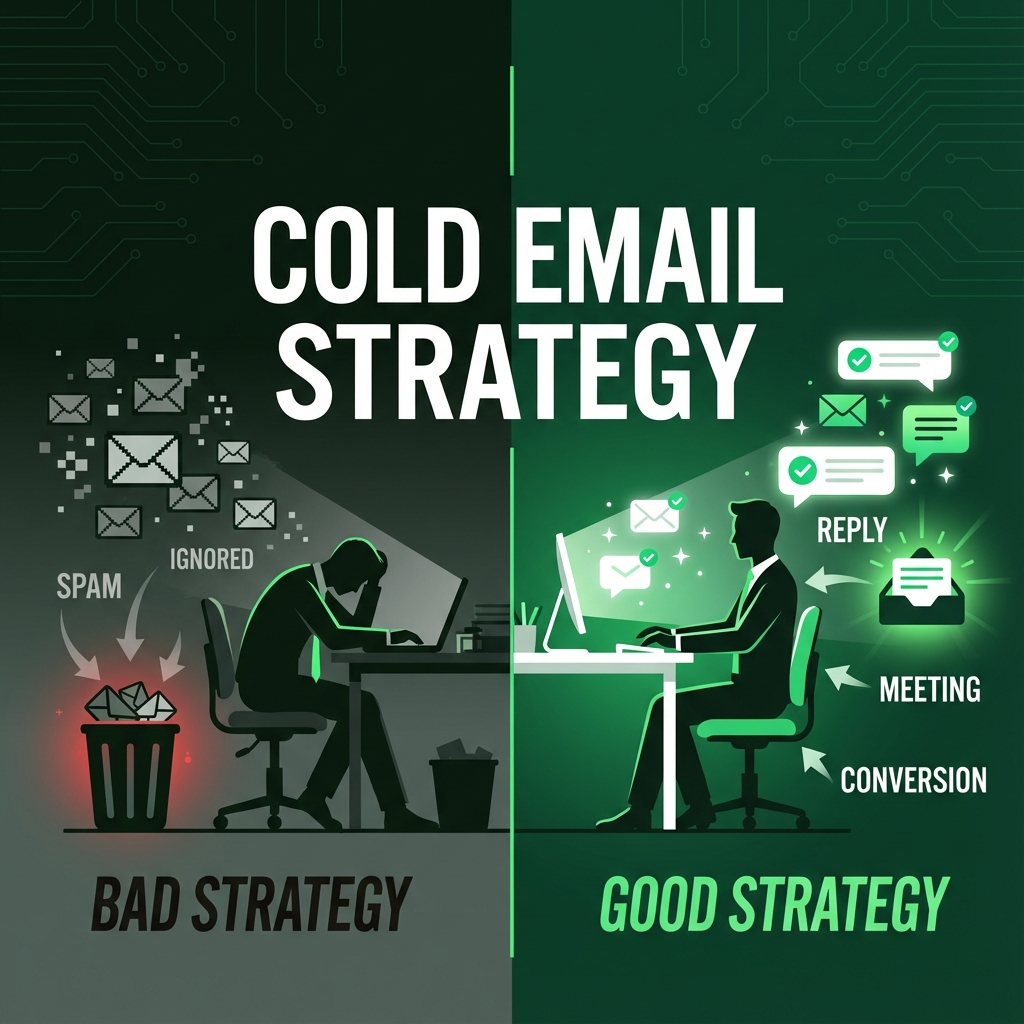
Cold email is often misunderstood in today's go-to-market strategy.
Sales teams keep rewriting templates, debating subject lines, testing personalization tokens, and investing in new copy frameworks. Yet reply rates continue to slide. Even teams with strong offers and experienced salespeople struggle to get prospects to engage.
Eventually, the question changes.
It moves from "What should we say in our cold emails?"
to "Why is nobody responding at all?"
The most common answer is copy. It feels logical. It's visible. It's the easiest thing to change.
But in most cases, it's the wrong diagnosis.
Copy is rarely the root cause of poor reply rates. It's the final piece of a much larger system—and usually not the part that's broken first.
The goal of this article is to explain why cold emails don't get replies at a system level, not a sentence level. Whether you work in GTM, outbound, or revenue, this is meant to help you understand what actually affects responses—not offer hacks or quick fixes.
Cold Email Is Not a Message. It's a System.
Cold Emailing Is Part of a Larger Process
A cold email is the result of many decisions made long before a sentence is written:
- Whether this person should be contacted at all
- How the email reaches their inbox
- When it arrives
- What the recipient is dealing with at that moment
- How (or if) follow-ups are handled
Most teams bundle all of these decisions into one idea: the message.
That simplification makes analysis easier—but it hides the real problems.
When outbound works, even average copy gets some traction. When it doesn't, no amount of clever wording brings it back. Attractive copy can't compensate for a broken system.
Over the past two decades, inboxes have changed. Buyers have changed. How people evaluate and purchase software has changed. But many outbound motions haven't kept up.
That gap—between how outbound is executed and how buyers actually behave—is why cold email responses keep declining.
To understand it, we need to walk through the process end to end.
Problem #1: You're Emailing People Who Were Never Going to Reply
Most outbound targeting is built on a comforting assumption:
"If someone fits our ICP, they'll eventually respond."
That assumption doesn't hold up.
Fit Does Not Create Replies. Readiness Does.
ICP-based targeting answers one question:
Could this person ever buy?
Replies depend on a different one:
Does this person have a reason to care right now?
Two people can share the same title, industry, and company size—and live in completely different realities.
One might be:
- Under pressure to hit a number
- Actively reviewing tools
- Dealing with a visible performance gap
The other might be:
- Focused internally
- Locked into existing systems
- Not thinking about the problem you solve
Your email reaches both. Only one was ever likely to reply.
Cold outreach breaks when it treats buyers as static profiles instead of people moving through changing contexts.
Why Traditional Targeting Breaks at Scale
Most targeting relies on static data:
- Job titles don't show urgency
- Firmographics don't reveal pressure
- Enrichment doesn't capture timing
This is why teams can keep "improving list quality" without improving replies.
Lists tell you who someone is.
Replies depend on what moment they're in.
Without signals of readiness, outreach becomes guesswork—sometimes lucky, often wasteful.
The Illusion of Precision
Another common mistake is over-filtering.
Teams aggressively narrow lists:
- Exact titles only
- Tight headcount ranges
- Highly specific industries
The result looks clean, but it removes variation in intent.
Outbound performs better when there's diversity in motivation—not just similarity on paper. When everyone looks the same, messaging becomes generic by necessity, even if it's technically personalized.
The Real Targeting Shift
Teams seeing consistent replies have moved from:
List-driven outbound → Signal-driven outbound
Signals don't guarantee replies, but they increase the odds dramatically. They indicate movement, friction, or change—conditions where outreach feels relevant instead of intrusive.
Most systems fail here not because signals don't exist, but because they're fragmented and ignored.
Problem #2: Deliverability Is Killing You Before Copy Has a Chance
Deliverability is the most underdiagnosed issue in outbound.
When copy is the problem, fixes behave predictably.
When deliverability is the problem, everything feels random.
Teams see:
- Sudden drops in replies
- Inconsistent results across domains
- Campaigns that worked before quietly dying
- "Good open rates" with no conversations
This happens because modern inboxes don't just block spam—they rank messages.
Inbox providers evaluate:
- Sending behavior
- Domain history
- Engagement patterns
- Likelihood of replies
When outbound scales too quickly or carelessly, inbox algorithms respond by reducing visibility. Not always by sending emails to spam—often by burying them where attention never reaches.
The email technically arrives. Practically, it doesn't exist.
Why This Gets Missed
Deliverability doesn't trigger alerts.
It doesn't break things overnight.
It simply lowers your ceiling.
Teams rewrite copy because that's what they can see. Meanwhile, reputation decay continues quietly in the background. By the time it's obvious, the damage is already done.
Problem #3: Your Timing Is Contextually Wrong
Most outbound advice treats timing like a scheduling problem.
Send on Tuesday.
Avoid Mondays.
Test 9:30 AM versus 11:00 AM.
If timing worked this way, reply rates wouldn't feel so unpredictable.
The reality is simpler—and harder to accept:
People don't reply when it's convenient for you.
They reply when it makes sense for them.
And those moments rarely align.
Timing isn't about clocks.
It's about headspace.
You've experienced this yourself. An email lands. It's fine. It's relevant. You think, I'll come back to this later. And then you don't.
Not because the email was bad—but because everything else was louder.
Cold emails fail when they arrive:
- Before the problem feels urgent
- When priorities are stacked
- When there's no mental space
Batch sending assumes context doesn't matter. It assumes repetition compensates for misalignment.
It doesn't.
Replies happen when a message intersects with a moment of change—pressure, curiosity, friction, urgency. That's not something a send-time rule can predict.
Problem #4: Personalization Isn't Relevance
At some point, personalization turned into a checklist.
First name.
Company name.
Job title.
Maybe a LinkedIn reference.
And still—no replies.
Because personalization answers who someone is.
Relevance answers why this matters now.
Think about the emails you actually reply to.
They're not the ones that say:
"Saw you're the Head of Sales at X."
They're the ones that make you pause and think:
"This is uncomfortably accurate."
Relevance isn't familiarity.
It's resonance.
Most cold emails describe the recipient. Very few speak to the situation they're in. When relevance is missing, replying feels like work—and silence becomes the easiest option.
Problem #5: Outbound Is Still Being Run Like a Manual Assembly Line
Here's a question most teams don't ask:
Why does outbound still feel so fragile?
Why does one change—a new list, a new sequence, a new sender domain—cause results to collapse?
Because most outbound systems were designed for a simpler time.
The typical setup looks like this:
- Humans decide targeting
- Tools send messages
- Sequences dictate behavior
- Reports explain failure later
That structure assumes the world stays still while outreach runs.
It doesn't.
Buyer behavior shifts. Inbox rules evolve. Context changes daily. Sequences don't adapt—they repeat.
So when results dip, teams push more volume. Volume hurts deliverability. Deliverability kills replies.
Outbound turns into noise—not because people don't care, but because the system doesn't respond to reality.
What Actually Improves Reply Rates
Replies don't improve through tweaks. They improve through alignment.
Teams that consistently get replies don't obsess over templates. They obsess over conditions.
They ask:
- Is this person likely to care now?
- Will this email actually be seen?
- Does the message fit the moment?
- Can outreach adapt if signals change?
When you zoom out, the pattern is clear.
Reply rates improve when:
- Targeting reflects readiness, not just fit
- Inbox reputation is protected before scale
- Timing responds to context
- Messaging adapts instead of repeating
This isn't automation for speed.
It's orchestration for relevance.
That's the shift modern GTM teams are making—and the gap between those chasing better copy and those fixing the system around it.
Fix the System, Not the Sentence
If there's one idea worth remembering:
Your cold emails aren't failing because of what you wrote.
They're failing because of where and when they land.
Copy matters—but only after everything else works.
Until then, rewriting sentences is like repainting a car with a broken engine. It feels productive. It doesn't change the outcome.
Fix the system first.
Then let the words do their job.